![High-quality HDPE, PPR, PE, and PVC pipes supplied to projects worldwide – [Ten Dharma Realms Pipeline Company] | Exported to Europe, America, the Middle East, Southeast Asia, and Central Asia,Factory direct wholesale](https://sfjindustry.com/wp-content/uploads/2026/03/cropped-更换logo背景为透明-1.png)
1. Introduction
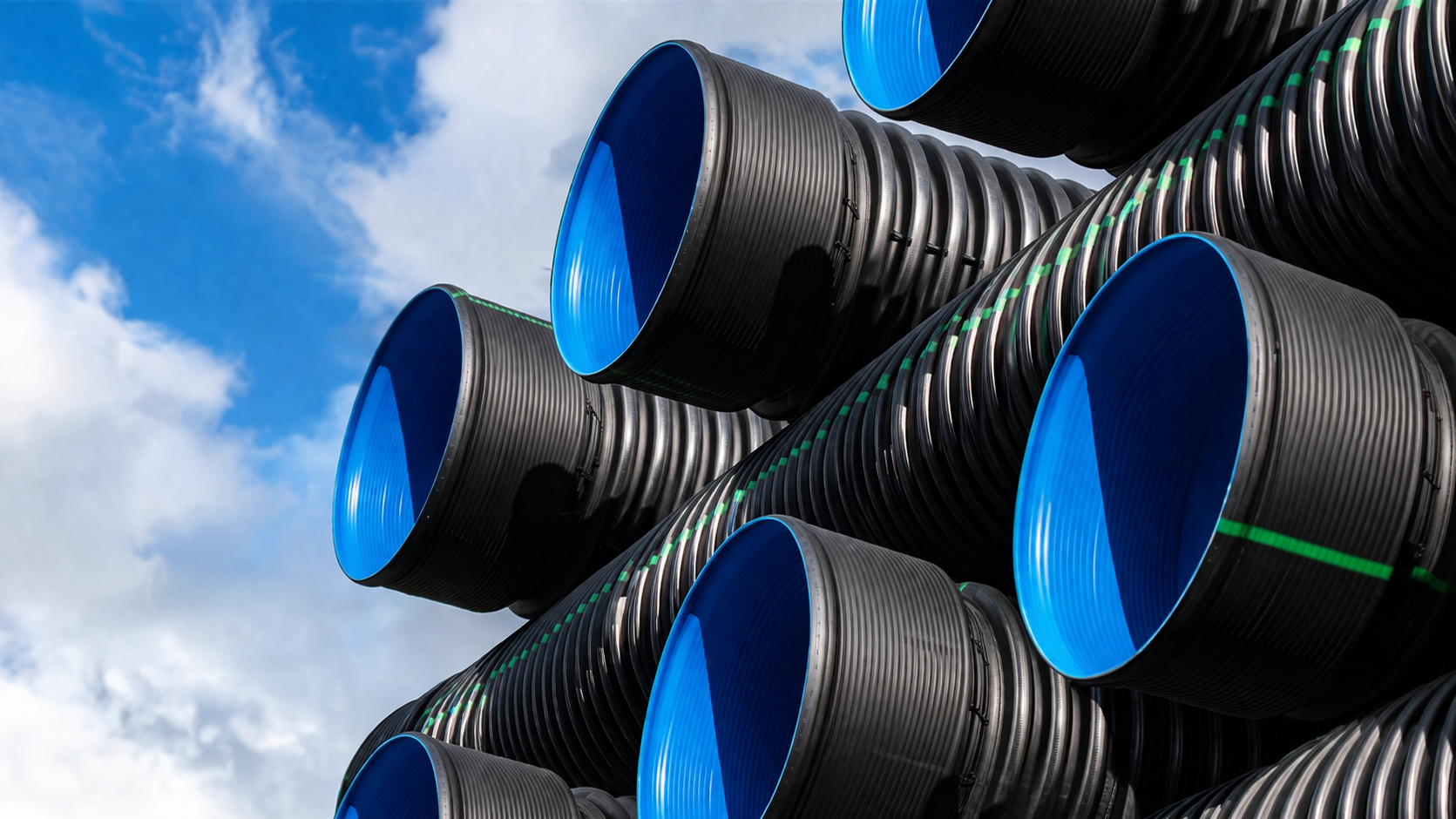
High-Density Polyethylene (HDPE) double-wall corrugated (DWC) pipe has become a widely adopted solution in modern buried pipeline systems, particularly for drainage, sewerage, and cable protection. Its structural configuration—combining a corrugated outer wall with a smooth inner wall—enables an optimized balance between mechanical strength and hydraulic efficiency.
From an engineering and procurement perspective, HDPE DWC pipes are typically evaluated based on compliance with international standards such as:
- ISO 4427 (polyethylene piping systems)
- GB/T 19472.1 (buried PE structural wall pipes)
- Relevant ASTM specifications for corrugated PE pipe systems
These standards define requirements for materials, dimensions, testing methods, and long-term performance, ensuring reliability in infrastructure applications.
2. Manufacturing Process
2.1 Raw Materials
- Primary material: PE80 or PE100 grade HDPE resin
- Additives: antioxidants, carbon black (UV resistance), stabilizers
HDPE is selected for its high strength-to-density ratio and resistance to chemical degradation.
2.2 Production Method
The manufacturing of DWC pipes typically uses a co-extrusion process:
- Dual extrusion:
- Inner layer: smooth bore (low friction)
- Outer layer: corrugated profile (structural stiffness)
- Vacuum forming & cooling:
- Corrugator molds shape the external ribs
- Cutting & inspection:
- Standard lengths (commonly 6 m)
- Quality checks per ISO/ASTM protocols
This process ensures consistent wall geometry and mechanical performance.
3. Performance Characteristics
3.1 Key Mechanical & Hydraulic Properties
| Property | Typical Performance | Engineering Value |
| Ring stiffness | SN4–SN16 classes | Suitable for varying burial depths |
| Service life | ≥50 years (design basis) | Long-term asset reliability |
| Impact resistance | High | Suitable for installation handling |
| Flexibility | Moderate–high | Adapts to soil settlement |
HDPE DWC pipes rely on soil-pipe interaction (flexible pipe design), where surrounding soil supports structural loads.
3.2 Chemical & Environmental Resistance
- Resistant to acids, alkalis, and wastewater constituents
- Immune to corrosion (unlike steel or concrete)
- No scaling or biological buildup on inner wall
These characteristics contribute to stable long-term hydraulic performance.
3.3 Hydraulic Efficiency
| Parameter | HDPE DWC Pipe | Conventional Concrete Pipe |
| Inner surface | Smooth | Rough |
| Flow resistance | Low | Higher |
| Self-cleaning velocity | Lower threshold | Higher threshold |
The smooth inner wall reduces friction losses and supports efficient flow, potentially allowing smaller diameter selection in design.
4. Dimensions & Technical Specifications
4.1 Standard Size Range
| Parameter | Typical Range |
| Nominal diameter (DN) | 100 – 1500 mm+ |
| Wall structure | Double-wall (smooth + corrugated) |
| Length | 5.8 m / 6 m / customized |
| Ring stiffness class | SN4, SN8, SN16 |
4.2 Example Dimensional Data
| DN (mm) | Inner Diameter (mm) | Outer Diameter (mm) |
| 300 | 290 | 310 |
| 600 | 570 | 630 |
| 1000 | 950 | 1050 |
4.3 Applicable Standards
| Standard | Scope |
| ISO 4427 | PE piping systems (water & general) |
| ISO 16770 | Long-term performance testing |
| GB/T 19472.1 | Buried PE corrugated pipes |
| ASTM (various) | Material, stiffness, joint testing |
5. Applications
HDPE DWC pipes are primarily used in non-pressure underground systems:
5.1 Municipal Infrastructure
- Stormwater drainage
- Sanitary sewer systems
- Combined sewer overflow (CSO)
5.2 Transportation & Civil Engineering
- Highway drainage systems
- Railway subgrade drainage
5.3 Industrial & Utility Applications
- Cable and telecom ducting
- Industrial wastewater discharge
5.4 Agriculture & Water Management
- Irrigation drainage
- Land reclamation systems
These applications benefit from corrosion resistance and long service life under aggressive soil conditions.
6. Selection Guide (Engineering & Procurement Focus)
6.1 Key Selection Parameters
| Factor | Recommendation |
| Load conditions | Select SN class (SN8+ for deep burial) |
| Soil type | Consider backfill quality & compaction |
| Flow requirement | Use hydraulic calculations (Manning’s equation) |
| Chemical exposure | Verify compatibility with HDPE |
| Installation method | Open trench vs trenchless |
6.2 Material & Standard Compliance
- Prefer PE100 grade for enhanced durability
- Verify compliance with:
- ISO / ASTM standards
- Third-party certifications (ISO 9001, CE)
6.3 Cost Considerations
| Cost Component | HDPE DWC Impact |
| Material cost | Moderate |
| Transportation | Low (lightweight) |
| Installation | Reduced labor/equipment |
| Maintenance | Typically low |
The total lifecycle cost is often optimized due to reduced installation and maintenance requirements.
7. Conclusion
HDPE double-wall corrugated pipes represent a technically mature and widely standardized solution for buried drainage infrastructure. Their dual-wall design delivers a practical combination of structural performance, hydraulic efficiency, and durability, aligning with modern engineering requirements.
From a procurement and design standpoint:
- Compliance with ISO, ASTM, and national standards is essential
- Selection should be based on load conditions, hydraulic demand, and installation environment
- Lifecycle cost analysis often favors HDPE over traditional materials
While performance advantages are well-documented, project-specific conditions—such as soil characteristics, installation quality, and design assumptions—remain critical to achieving expected service life.