![High-quality HDPE, PPR, PE, and PVC pipes supplied to projects worldwide – [Ten Dharma Realms Pipeline Company] | Exported to Europe, America, the Middle East, Southeast Asia, and Central Asia,Factory direct wholesale](https://sfjindustry.com/wp-content/uploads/2026/03/cropped-更换logo背景为透明-1.png)
1. Introduction
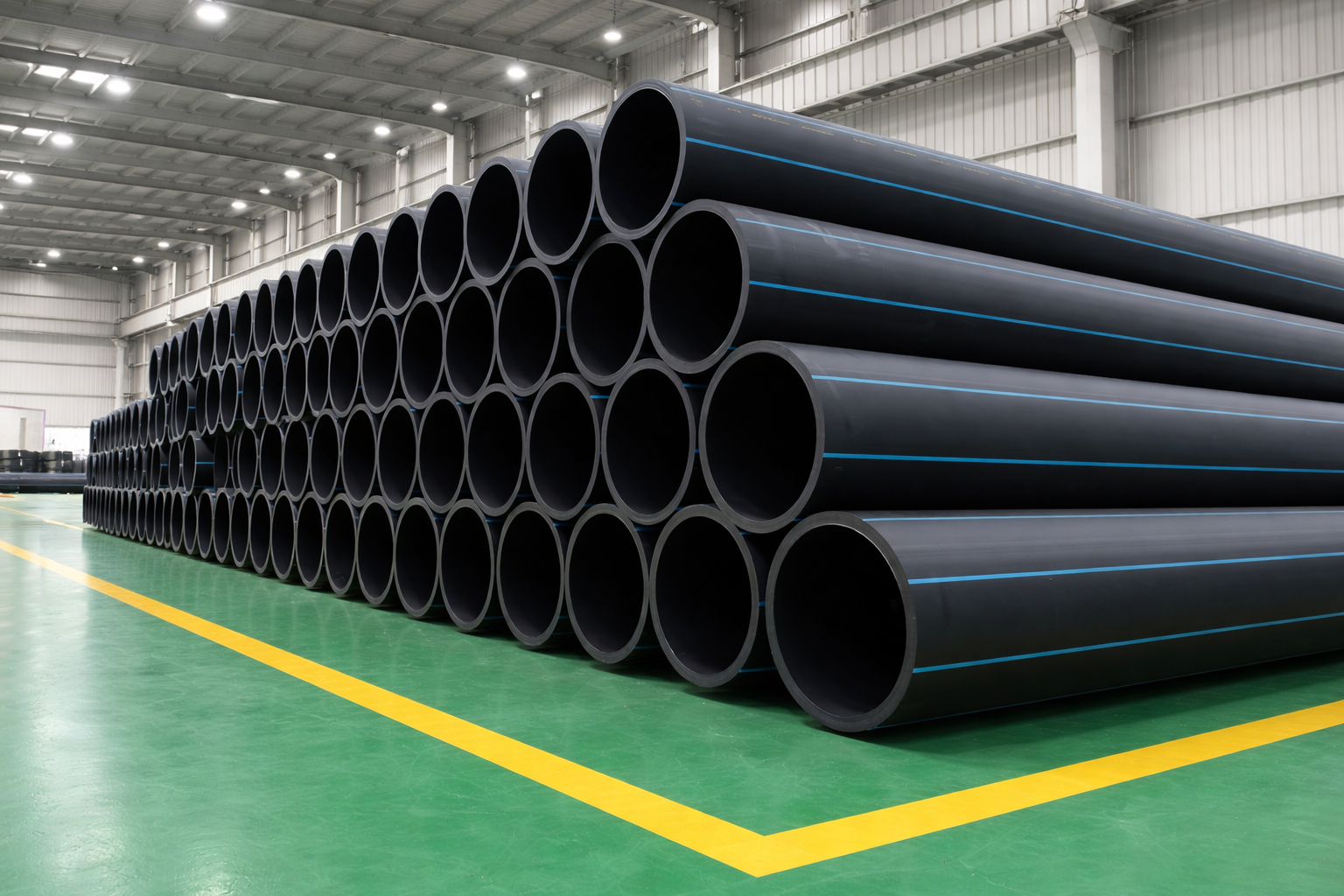
Polyethylene (PE) pipe is a thermoplastic piping solution widely used in water supply, gas distribution, industrial fluid handling, and infrastructure systems. Its adoption has increased significantly due to its corrosion resistance, flexibility, and lifecycle cost advantages.
Modern PE piping systems are governed by internationally recognized standards such as:
- ISO 4427 – Water supply systems
- ISO 4437 – Gas distribution
- ASTM F714 – Large-diameter PE pipe specifications
- EN 12201 / AWWA C906 – Municipal and industrial applications
These standards ensure dimensional consistency, pressure integrity, and long-term performance, often based on a design life of 50+ years under specified conditions.
2. Manufacturing Process
2.1 Raw Materials
PE pipes are produced from polyethylene resins classified by Minimum Required Strength (MRS):
| Grade | MRS (MPa) | Typical Use |
| PE63 | 6.3 | Legacy systems |
| PE80 | 8.0 | Medium-pressure |
| PE100 | 10.0 | High-performance pipelines |
2.2 Extrusion Process
The dominant manufacturing method is continuous extrusion, involving:
- Resin melting in an extruder
- Homogeneous mixing with stabilizers (e.g., carbon black for UV resistance)
- Die shaping (defines OD and wall thickness)
- Vacuum calibration and cooling
- Haul-off and cutting
This process ensures tight dimensional tolerances and consistent mechanical properties .
2.3 Joining Methods
| Method | Application | Notes |
| Butt Fusion | Large diameter pipelines | Homogeneous joint |
| Electrofusion | Repair & confined spaces | High reliability |
| Mechanical Coupling | Temporary / special cases | Faster installation |
3. Performance Characteristics
3.1 Mechanical and Physical Properties
| Property | Typical Performance |
| Corrosion Resistance | Excellent (inert to most chemicals) |
| Flexibility | High (tolerates ground movement) |
| Impact Resistance | Strong, even at low temperatures |
| Density | ~0.94–0.96 g/cm³ |
| Service Life | ≥50 years (design basis) |
PE pipes demonstrate resistance to internal pressure and slow crack growth, verified by standardized testing such as ISO 1167 pressure testing .
3.2 Hydraulic Performance
- Smooth internal surface → low friction loss
- Reduced scaling compared to metal pipes
- Suitable for slurry and wastewater transport
3.3 Chemical Resistance
PE pipes are widely used for:
- Acids and alkalis
- Wastewater and effluents
- Industrial fluids
However, compatibility should be verified for strong oxidizing agents (per ASTM guidance).
4. Dimensions & Technical Specifications
4.1 Key Parameters
| Parameter | Definition |
| OD (De) | Outside diameter |
| SDR | Standard Dimension Ratio = OD / Wall Thickness |
| PN | Nominal pressure rating (bar) |
| MRS | Minimum Required Strength |
4.2 SDR vs Pressure Rating (PE100 Example)
| SDR | PN (bar) | Typical Application |
| SDR 11 | 16 | Water distribution |
| SDR 13.6 | 12.5 | Medium pressure |
| SDR 17 | 10 | General pipelines |
| SDR 21 | 8 | Low pressure |
| SDR 26 | 6.3 | Irrigation |
Key Insight:
- Lower SDR → thicker wall → higher pressure capacity
- Higher SDR → thinner wall → lower pressure rating
4.3 Dimensional Range
Typical production ranges:
- Diameter: DN 16 – DN 1200 mm
- Pressure classes: PN4 – PN25
4.4 Pressure Calculation Basis
Pressure rating is derived from:
- Material strength (MRS)
- Safety factor (~1.25 per ISO)
- SDR relationship
This ensures long-term hydrostatic strength compliance .
5. Applications
PE pipes are widely used across sectors:
5.1 Municipal Infrastructure
- Potable water distribution
- Sewer and drainage systems
- Trenchless rehabilitation (lining, pipe bursting)
5.2 Energy Sector
- Natural gas distribution (ISO 4437 compliant)
- Oil & slurry pipelines
5.3 Industrial Systems
- Chemical transport
- Mining slurry pipelines
- Cooling water systems
5.4 Agriculture & Irrigation
- Drip irrigation
- Low-pressure water conveyance
6. Selection Guide (Engineering & Procurement Focus)
6.1 Material Grade Selection
| Condition | Recommended Grade |
| High pressure / critical systems | PE100 |
| Medium pressure | PE80 |
| Low pressure / non-critical | PE63 |
6.2 SDR / Pressure Selection
| Application | Typical SDR |
| Urban water main | SDR 11–17 |
| Gas distribution | SDR 11 |
| Irrigation | SDR 17–26 |
6.3 Key Procurement Considerations
- Compliance with ISO / ASTM / EN standards
- Certification (e.g., potable water approval)
- Manufacturer quality control (MFR, density, hydrostatic testing)
- Jointing method compatibility
- UV resistance (carbon black content)
6.4 Installation Considerations
- Allow for thermal expansion
- Ensure proper fusion procedures
- Consider derating for elevated temperatures
7. Conclusion
PE (Polyethylene) pipe represents a mature, standards-driven solution for modern pipeline systems. Its advantages—such as corrosion resistance, flexibility, and lifecycle efficiency—make it suitable for a wide range of applications from municipal infrastructure to industrial systems.
However, effective implementation depends on correct specification and engineering judgment, particularly in:
- SDR and pressure selection
- Material grade (PE80 vs PE100)
- Compliance with ISO/ASTM standards
For engineering and procurement professionals, PE pipe offers reliable performance when specified within standard-defined limits and validated through proper testing protocols.