![High-quality HDPE, PPR, PE, and PVC pipes supplied to projects worldwide – [Ten Dharma Realms Pipeline Company] | Exported to Europe, America, the Middle East, Southeast Asia, and Central Asia,Factory direct wholesale](https://sfjindustry.com/wp-content/uploads/2026/03/cropped-更换logo背景为透明-1.png)
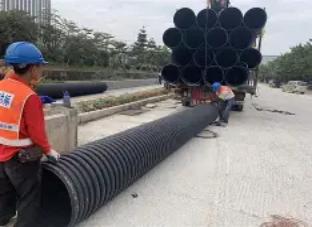
1. Overview of HDPE Double-Wall Corrugated Pipe Engineering
1.1 Basic Product Advantages
HDPE double-wall corrugated pipe is a mainstream drainage pipeline material.
It is widely used in global rainwater and sewage drainage projects.
First, this pipe has excellent physical performance.
It features light weight and high ring stiffness.
Common ring stiffness grades include SN4 and SN8.
These grades can meet different buried depth construction demands.
Second, it has strong corrosion resistance.
It will not be eroded easily by sewage impurities and rainwater sediment.
Its anti-aging property extends the whole service life of drainage pipelines.
Compared with traditional concrete pipes, HDPE corrugated pipes are easier to transport.
They also save more construction labor costs.
For these reasons, they are popular in municipal infrastructure construction overseas.
1.2 Application Scope of Rainwater and Sewage Projects
In rainwater engineering, HDPE double-wall corrugated pipes collect surface water.
They drain accumulated rainwater on roads, communities and parks rapidly.
In sewage engineering, these pipes transport domestic sewage and light industrial sewage.
They ensure smooth discharge of polluted water without internal leakage.
The applicable pipe diameter ranges from DN160 to DN600.
This size range covers most municipal and rural drainage construction needs.
It adapts to plain terrain and gentle slope terrain construction environments.
1.3 Core Construction Principles
All construction work must follow local municipal drainage engineering standards.
Construction personnel need to clarify design drawings first.
Next, unified construction standards shall be implemented in the whole process.
Every construction link needs strict quality inspection.
Safety construction and standardized operation shall be guaranteed.
Meanwhile, pipeline drainage gradient must meet design requirements.
This avoids later water blockage and pipeline deposition problems.
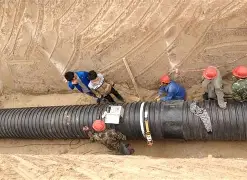
2. Pre-Construction Preparation Work
2.1 On-site Survey and Layout Measurement
Before formal construction, staff carry out comprehensive on-site survey.
They confirm pipeline laying routes and actual terrain conditions.
Then, surveyors set out pipeline center lines and trench side lines accurately.
They mark buried depth data and elevation control points clearly.
All measured data shall be recorded in real time.
The recorded data shall be compared with construction drawings repeatedly.
If there is any deviation, it shall be adjusted in time.
Reasonable construction access shall be planned on site.
It ensures smooth passage of construction vehicles and mechanical equipment.
2.2 Construction Material Inspection and Acceptance
All incoming HDPE double-wall corrugated pipes need strict appearance inspection.
Check whether pipe walls have cracks, depressions and damage marks.
Matching rubber sealing rings are key auxiliary materials.
Check the elasticity and complete degree of each sealing ring.
Unqualified accessories are forbidden to be used.
In addition, inspect pipe fittings such as straight joints and reducing joints.
Ensure all accessories match the pipe diameter specifications.
Store qualified pipes in flat and dry areas.
Keep them away from sharp hard objects.
Also, avoid long-term direct sunlight exposure to prevent pipe aging.
2.3 Mechanical Equipment and Personnel Arrangement
Prepare complete construction machinery in advance.
Main equipment includes excavators, pipe hoists and compacting machines.
Check the running state of all mechanical devices.
Maintain and debug equipment to ensure stable operation during construction.
Arrange professional construction teams.
All operators need to master basic pipe laying skills.
They also need to know standardized connection methods.
Furthermore, assign special quality supervisors and safety managers.
They supervise on-site construction progress and construction quality all the time.
2.4 Construction Scheme Confirmation and Technical Disclosure
Combine on-site actual conditions to confirm detailed construction schemes.
Distinguish different construction standards of rainwater pipes and sewage pipes.
Sewage pipelines need higher sealing requirements.
For this reason, related construction details shall be emphasized separately.
Organize technical disclosure meetings.
Engineers explain construction difficulties and key control points to all staff.
Unify construction operation specifications.
Let every worker clarify their own job responsibilities and operation norms.
3. Trench Excavation and Foundation Treatment Construction
3.1 Standardized Trench Excavation Operation
Excavate drainage trenches strictly according to measured setting-out lines.
Control trench width according to outer diameter of pipelines and construction operation space.
Keep the inner wall of the trench neat and smooth.
Remove all sharp stones, tree roots and hard sundries inside the trench.
Control trench excavation depth reasonably.
Reserved foundation treatment thickness shall not exceed the standard range.
In soft soil foundation areas, slow down excavation speed.
This prevents trench wall collapse and side slope sliding accidents.
3.2 Trench Side Slope Protection Treatment
For deep buried pipeline trenches, do a good job in side slope support protection.
Use supporting plates to fix loose soil layers.
In rainy construction periods, strengthen side slope monitoring.
Once soil loosening is found, stop excavation immediately for reinforcement treatment.
Set temporary drainage ditches around trenches.
Discharge accumulated surface water outside construction areas in time.
Do not let rainwater flow directly into newly excavated trenches.
This prevents foundation soil from being soaked and softened.
3.3 Pipeline Foundation Sand Cushion Laying
After trench bottom finishing is completed, start laying graded sand cushion layer.
Choose clean fine sand without impurities as foundation filler.
Control the laying thickness of sand cushion in accordance with design standards.
Spread the sand evenly on the flat trench bottom.
Use manual tools to level the sand cushion surface.
Ensure the overall flatness meets pipe laying basic requirements.
Carry out slight compaction on the sand cushion.
Keep the foundation bearing force uniform without local hollow areas.
3.4 Foundation Gradient Adjustment
Adjust the overall gradient of the pipeline foundation strictly in line with drainage design data.
Reasonable gradient is the key to smooth drainage.
Rainwater pipelines can adopt conventional drainage gradient.
Sewage pipelines need to adjust gradient according to sewage flow.
Recheck elevation data after gradient adjustment.
Ensure the whole pipeline forms a stable water flow trend.
Unqualified foundation gradient must be reworked and adjusted.
Do not reserve hidden quality dangers.
4. Hoisting, Lowering and Pipeline Alignment Work
4.1 Safe Hoisting of HDPE Pipes
Use professional soft slings to lift HDPE double-wall corrugated pipes.
Hard steel wire ropes are forbidden to bind pipes directly.
Control hoisting speed steadily.
Avoid violent shaking and collision between pipes during hoisting process.
Commanders and hoisting operators cooperate closely.
Ensure pipes are transported to designated trench positions safely.
Classified hoisting shall be carried out according to pipe diameters.
Do not allow mixing placement of different specification pipes.
4.2 Stable Pipe Lowering Construction
Place the lifted pipes slowly on the processed sand cushion foundation.
Workers assist in adjusting the placement position manually.
Make each single pipe fit closely with the pipeline center line.
Keep the horizontal position of pipes consistent.
Leave reasonable operation gaps between adjacent pipes.
This is convenient for later socket connection construction.
Avoid rolling and displacement of pipes after lowering.
Fix the position of single pipes properly in time.
4.3 On-site Pipeline Overall Alignment
After all single pipes are lowered in place, carry out overall straightening work.
Adjust the deviation of each section of pipeline.
Keep the linearity of the whole drainage pipeline smooth.
Reduce local bending and position deviation phenomena.
Cooperate with elevation measuring tools to fine-tune pipe height.
Ensure the horizontal and vertical positions fully meet drawing standards.
Finish alignment work section by section.
Conduct preliminary quality inspection after each section is adjusted well.
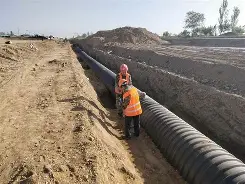
5. Core Socket Connection Construction Technology
5.1 Preparatory Work Before Interface Connection
Clean the inner and outer parts of pipe sockets and spigots thoroughly.
Wipe away sediment, dust and sundries inside and outside pipe mouths.
Check the intact state of rubber sealing rings again.
Confirm no deformation, fracture and aging damage exist.
Install the sealing ring at the fixed groove of the pipe spigot.
Ensure the sealing ring is installed in place without deviation and warping.
Smear a small amount of professional lubricant on the surface of the sealing ring.
This can reduce connection friction and avoid ring displacement.
5.2 Standard Socket Push-in Operation
Align the spigot end with the socket end accurately.
Keep the two pipes on the same horizontal straight line.
Adopt manual matching simple mechanical tools for slow push-in operation.
Do not use violent knocking for forced assembly.
Control the push-in depth strictly according to marking lines on pipes.
Excessive or insufficient insertion will affect interface sealing effect.
Keep the force uniform during push-in.
Prevent single-side deviation leading to sealing ring dislocation.
5.3 Interface Sealing Inspection and Correction
After pipe connection is completed, check the tightness of all interfaces visually.
Observe whether there are gaps and looseness at joints.
Twist and shake connected pipes slightly for auxiliary inspection.
Qualified interfaces have no loose shaking sense.
For unqualified connected interfaces, separate the pipes again for reinstallation.
Replace damaged sealing rings timely.
All joint connection details shall be recorded on site.
It is convenient for later quality review and maintenance.
5.4 Different Requirements for Rainwater and Sewage Interfaces
Rainwater pipeline interfaces focus on basic tightness.
They can meet conventional rainwater drainage and anti-seepage demands.
On the other hand, sewage pipeline interfaces need higher sealing standards.
All joints must achieve zero leakage standard.
For this reason, increase interface sampling inspection quantity in sewage pipe sections.
Strictly control hidden leakage problems of sewage pipelines.
6. Manhole and Pipeline Connecting Construction
6.1 Pre-installation Inspection of Drainage Manholes
Check the production quality and size specification of prefabricated drainage manholes.
Confirm matching degree between manhole openings and pipe diameters.
Clean up sundries inside manholes and reserved connecting openings.
Keep the connecting positions smooth and tidy.
Check the installation verticality of manholes.
Ensure manholes are stably fixed on the designated foundation positions.
6.2 Pipeline and Manhole Butt Joint Construction
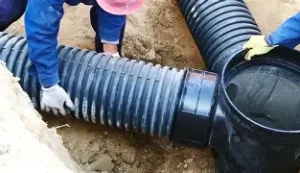
Align the pipe end with the reserved connecting opening of the manhole.
Adjust the horizontal height and connecting angle accurately.
Fill the gap between pipeline and manhole with waterproof mortar.
Fill all gaps densely without hollow gaps.
Strengthen the external sealing treatment of connecting parts.
Enhance anti-seepage and anti-leakage performance of connecting positions.
Keep the inner wall of the connecting position flat and smooth.
Avoid protruding obstacles affecting normal water flow.
6.3 Overall Finishing of Manhole Periphery
Level the soil around the installed manholes.
Keep the surrounding ground neat and consistent.
Set up obvious warning signs beside manholes.
Prevent construction vehicles from colliding and damaging manhole structures.
Check the water passing smoothness inside manholes.
Ensure no sundries block internal drainage passages.
7. Pipeline Inspection and Pressure Sealing Test
7.1 Visual Overall Appearance Inspection
After pipeline laying is fully completed, carry out full-line appearance inspection.
Check pipe overall linearity and buried position accuracy.
Recheck all connecting joints and manhole connecting parts.
Eliminate all visible installation defects.
Sort out construction waste inside pipelines.
Ensure the inner cavity of pipes is clean and unobstructed.
7.2 Closed Water Test for Sewage Pipelines
Closed water test is a necessary inspection procedure for sewage drainage projects.
It effectively detect pipeline overall anti-leakage performance.
Block two ends of the tested pipeline sections tightly.
Inject clean water into the pipeline up to the specified test water level.
Keep the water storage state for a fixed time period.
Observe whether pipeline interfaces and pipe bodies have seepage and water leakage phenomena.
Record test data completely.
Only sections passing the closed water test can enter the next backfill procedure.
7.3 Conventional Flow Test for Rainwater Pipelines
Rainwater pipelines can adopt simple water flow test instead of closed water test.
Pour a certain amount of water to test drainage smoothness.
Check whether there is water retention and slow flow inside rainwater pipes.
Adjust local gradient problems in time.
Confirm that rainwater can be discharged to designated collecting areas rapidly.
Meet regional rainwater quick drainage demands.
7.4 Problem Rectification after Inspection
For pipelines with leakage and unqualified drainage effect, mark problem positions clearly.
Arrange professional personnel for targeted rectification.
Replace severely damaged pipes and failed sealing accessories again.
Re-inspect after rectification is finished.
All hidden construction quality problems must be solved before backfill construction.
8. Trench Backfill and Layered Compaction Construction
8.1 Selection of Backfill Filling Materials
Choose qualified sandy soil and fine soil as main backfill materials.
Hard soil blocks, large stones and construction waste are forbidden to be used for backfill.
Ensure backfill soil has no corrosive ingredients.
Avoid long-term corrosion and damage to outer walls of HDPE pipes.
Classify backfill materials according to different laying layers.
Use fine filler near pipe bodies preferentially.
8.2 Layered Symmetrical Backfill Operation
Carry out symmetrical backfill construction on both sides of pipelines strictly.
Do not allow single-side unilateral backfill.
Control the thickness of each backfill layer within the standard range.
Thick one-time backfill easily causes pipeline displacement and deformation.
Spread backfill soil evenly manually near pipe walls.
Prevent mechanical filling from impacting and squeezing pipe bodies.
Backfill construction shall be carried out section by section.
Keep the backfill progress consistent with pipeline laying progress.
8.3 Standard Layered Compaction Construction
Use light compacting equipment to compact the soil layer close to pipelines.
Reduce extrusion force on HDPE pipe walls.
Increase compaction strength appropriately for surface soil layers.
Improve overall ground stability after backfill.
Check the compactness of each compacted soil layer.
Ensure the backfill firmness meets road recovery and ground use standards.
Avoid over-compaction leading to pipeline wall deformation.
Protect the structural integrity of double-wall corrugated pipes.
8.4 Surface Ground Finishing Treatment
After trench backfill reaches the designed height, level the overall construction ground.
Restore original terrain and road flatness.
Clean residual construction sundries on the construction site.
Sort out construction tools and idle mechanical equipment.
Mark pipeline laying routes and buried depth warning lines on the ground.
It provides convenience for later pipeline maintenance and renovation.
9. Later-stage Construction Acceptance and Daily Maintenance Suggestions
9.1 Completion Acceptance Work of Drainage Projects
Sort out all construction data and test reports completely.
Submit complete materials for project overall acceptance.
Acceptance personnel inspect on-site construction effect in person.
Check pipeline laying quality, backfill compactness and drainage effect.
Confirm that all construction links comply with international drainage engineering construction norms.
Sign relevant acceptance documents after reaching the standard.
9.2 Daily Pipeline Use Protection Points
Avoid heavy vehicles pressing the ground above buried pipelines for a long time.
Prevent excessive pressure from causing pipe body deformation.
Regularly clean sediment and sundries inside rainwater and sewage pipelines.
Reduce pipeline blockage probability.
Timely inspect aging and loosening phenomena of pipeline interfaces.
Replace failed sealing parts in advance.
9.3 Common Construction Fault Prevention Measures
Control excavation depth strictly in construction to avoid excessive excavation damaging original geological structure.
Standardize interface connection operations to reduce water leakage failure rate of drainage pipelines.
Do a good job in rainy season construction protection.
Prevent foundation softening and trench collapse affecting construction quality.
9.4 Long-term Engineering Operation Optimization
Combine local rainfall and sewage discharge volume.
Regularly optimize pipeline internal drainage flow efficiency.
Establish complete pipeline maintenance files.
Record construction information and daily inspection data in detail.
Popularize standardized HDPE double-wall corrugated pipe construction experience.
Promote efficient and high-quality development of overseas municipal drainage projects.
Partner Links: