Choosing the right pipeline material is critical for municipal drainage, water supply, and underground construction projects.
Developers, contractors, and city planners always face a key decision: plastic pipe or metal pipe.
Service life, upfront cost, long-term maintenance, corrosion resistance, and installation difficulty all affect project budget and durability.
This article compares plastic pipe and metal pipe in full detail.
It covers service life, material cost, installation expense, maintenance fees, and long-term operational value.
Readers will gain clear guidance for selecting drainage pipe, sewer pipe, and water supply pipe for urban infrastructure builds.
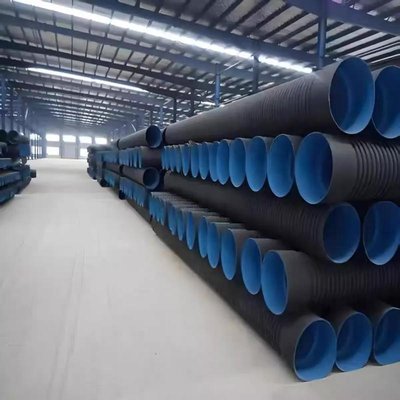
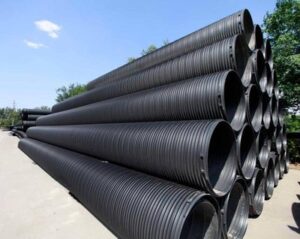
Factory supply HDPE double wall corrugated pipe with high ring stiffness, excellent corrosion resistance and over 50 years service life, ideal for municipal rain and sewage separation, residential drainage and underground pipe network renovation.
1. Basic Overview of Plastic Pipe and Metal Pipe
1.1 Common Types of Plastic Pipe
Plastic pipe mainly includes HDPE pipe, PVC pipe, PP pipe, and PE sewage pipe.
These plastic pipeline products are widely used in rain and sewage separation, urban drainage, and residential water supply.
Plastic pipe features lightweight structure, smooth inner wall, and strong anti-corrosion performance.
It does not easily rust or scale under long-term underground burial.
1.2 Common Types of Metal Pipe
Metal pipe covers steel pipe, cast iron pipe, ductile iron pipe, and galvanized iron pipe.
Metal pipe has high hardness and strong pressure resistance.
It was the mainstream choice for urban water supply and drainage in the early construction era.
Metal pipe relies on metal material toughness to bear external soil pressure and heavy traffic load.
2. Service Life Comparison: Plastic Pipe vs Metal Pipe
2.1 Service Life of Plastic Pipe
Plastic pipe has outstanding anti-aging and anti-corrosion properties.
Standard HDPE pipe and PVC pipe offer a designed service life of 50 to 100 years under normal underground conditions.
Plastic pipe resists acid, alkali, groundwater erosion, and chemical sewage corrosion.
No rust, no metal oxidation, and no pipe wall thinning over time.
With professional buried installation, plastic pipe maintains stable performance for decades.
It rarely leaks or deforms in urban drainage and sewer systems.
2.2 Service Life of Metal Pipe
Metal pipe has a shorter actual service life compared to plastic pipe.
Ordinary galvanized metal pipe usually lasts only 15 to 30 years.
Cast iron pipe and ductile iron pipe can reach 30 to 50 years under ideal environments.
Once encountering humid soil, chemical wastewater, or saline land, metal pipe corrodes rapidly.
Rust, pipe wall perforation, and joint leakage are common failures of aging metal pipe.
Frequent replacement becomes inevitable in old urban pipeline networks.
2.3 Core Factors Affecting Pipeline Service Life
Soil quality, groundwater composition, burial depth, and traffic load all impact pipeline lifespan.
Plastic pipe is far less affected by harsh soil and chemical environments.
Metal pipe requires anti-corrosion coating and regular protection to extend usage time.
Metal pipe depends on steel and iron raw materials, which fluctuate greatly with market trends.
Metal pipe per-meter material cost is significantly higher than plastic pipe of the same specification.
For large-scale municipal drainage projects, plastic pipe saves substantial material investment.
3.2 Installation and Construction Cost
Plastic pipe is lightweight and easy to transport and handle.
It adopts flexible connection, hot melt welding, and simple assembly methods.
Construction speed is fast, labor demand is low, and project construction period is shortened.
Metal pipe is heavy and requires large machinery for hoisting and alignment.
Installation needs professional anti-corrosion treatment, rigid flange connection, and complex construction steps.
Labor cost and mechanical cost of metal pipe installation are much higher than plastic pipe.
3.3 Maintenance and Replacement Cost
Plastic pipe almost requires no daily maintenance.
Its smooth inner wall avoids scaling, blockage, and pipeline deformation.
Leakage and failure rates remain extremely low throughout the service life.
Metal pipe needs regular rust removal, anti-corrosion repainting, and leakage inspection.
Aging metal pipe often needs partial excavation, cutting, and replacement.
Long-term maintenance and renewal costs of metal pipe accumulate into huge hidden expenses.
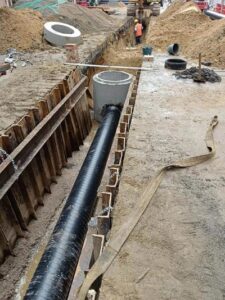
HDPE pipe installation site with hot melt welding for leak-proof joints. Flexible material adapts to ground settlement, widely used in urban water supply, sewage discharge and trenchless rehabilitation projects.
4. Performance Comparison in Practical Engineering
4.1 Corrosion Resistance
Corrosion resistance is the biggest gap between plastic pipe and metal pipe.
Plastic pipe is non-metallic and never rusts.
It adapts to sewage drainage, chemical industrial pipelines, and coastal saline soil areas.
Metal pipe is inherently prone to electrochemical corrosion.
Underground humid environments accelerate metal oxidation and pipe damage.
In rain and sewage separation projects, plastic pipe is more reliable long-term.
4.2 Flow Capacity and Inner Wall Smoothness
Plastic pipe has a smooth inner wall with low friction resistance.
Water flow speed is fast, and dirt is not easy to adhere.
It improves drainage efficiency and reduces pipeline blockage frequency.
Metal pipe inner wall easily rusts and scales.
Over time, the effective pipe diameter shrinks, affecting water supply and drainage capacity.
![High-quality HDPE, PPR, PE, and PVC pipes supplied to projects worldwide – [Ten Dharma Realms Pipeline Company] | Exported to Europe, America, the Middle East, Southeast Asia, and Central Asia,Factory direct wholesale](https://sfjindustry.com/wp-content/uploads/2026/03/cropped-更换logo背景为透明-1.png)