![High-quality HDPE, PPR, PE, and PVC pipes supplied to projects worldwide – [Ten Dharma Realms Pipeline Company] | Exported to Europe, America, the Middle East, Southeast Asia, and Central Asia,Factory direct wholesale](https://sfjindustry.com/wp-content/uploads/2026/03/cropped-更换logo背景为透明-1.png)
Introduction
1.1 Growing Demand for Reliable Gas Infrastructure
Natural gas plays a key role in the transition to low-carbon energy.
Many countries are expanding their gas distribution networks.
These networks require durable, leak-proof pipeline solutions.
Traditional metal pipes often fail to meet modern performance demands.
Older metal pipelines face corrosion and failure risks.
These risks threaten public safety and operational efficiency.
Thus, the industry has shifted toward advanced polymer solutions.
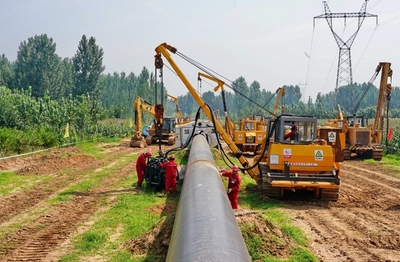
HDPE pipes have emerged as the leading choice for gas pipeline transportation.
1.2 Limitations of Traditional Gas Pipes
However, these materials have significant drawbacks.
First, metal pipes are prone to electrochemical corrosion.
Corrosion weakens pipe walls and causes leaks over time.
Leaks lead to safety hazards and costly repairs.
Cathodic protection systems demand ongoing monitoring.
Anti-corrosion treatments add long-term operational costs.
These costs increase the total lifecycle expense of metal pipelines.
They crack under ground settlement or seismic activity.
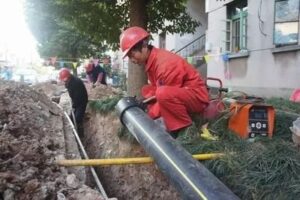
Installation also requires heavy equipment and skilled labor.
This slows construction and raises project costs.
These issues create demand for a more reliable alternative.
1.3 Emergence of HDPE Gas Pipeline Solutions
Early applications focused on small-diameter service lines.
Material technology advanced rapidly in the following decades.
PE80 and PE100 grades were developed for higher pressure ratings.
These grades offered improved strength and crack resistance.
Over 90% of new gas service lines in Europe use HDPE.
North America and Asia have adopted similar trends.
HDPE pipes now support pressures up to 16 bar in gas applications.
They serve diameters from 20mm to over 1200mm.
This versatility makes them ideal for diverse infrastructure projects.
2. Key Properties of HDPE Pipes for Gas Transportation
2.1 PE80 vs. PE100 Material Grades
PE80 was the first widely adopted high-performance grade.
It has a minimum required strength (MRS) of 8.0 MPa at 20°C.
PE80 pipes remain suitable for low-pressure gas applications.
It has an MRS of 10.0 MPa at 20°C.
This 25% strength increase allows thinner pipe walls.
Thinner walls reduce material costs and overall pipe weight.
PE100 also offers superior resistance to slow crack growth.
It provides enhanced protection against point loads and scratches.
This makes it ideal for non-excavation installation methods.
PE100-RC minimizes risks during trenchless construction.
It has become the preferred choice for modern gas infrastructure projects.
2.2 Critical Performance Features
They are immune to corrosion from soil, water, and chemicals.
This eliminates the need for protective coatings or linings.
The pipe interior remains smooth throughout its service life.
This reduces pressure loss and maintains consistent gas flow.
This property improves gas flow efficiency in the pipeline.
Smaller-diameter pipes can carry the same volume of gas.
This reduces material costs and energy consumption for utilities.
They can bend up to 20 times their diameter without breaking.
This flexibility allows them to absorb ground movement.
They resist damage from earthquakes and soil settlement.
Flexibility also simplifies installation around existing utilities.
They weigh approximately 1/8 of steel pipes of the same size.
Lightweight pipes are easier to transport and handle.
They require fewer workers and less heavy equipment on site.
This reduces installation time and labor costs significantly.
2.3 Long-Term Durability and Performance
This lifespan is based on extensive long-term testing.
The pipes maintain their mechanical properties over decades.
They do not become brittle under normal operating conditions.
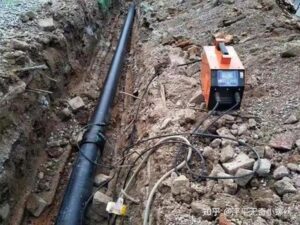
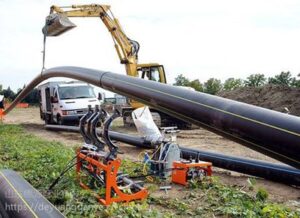
Thermofusion welding creates a permanent molecular bond.
The joint strength matches or exceeds the pipe itself.
This eliminates the most common failure point in pipeline systems.
Gas distribution networks experience regular pressure fluctuations.
HDPE handles these cycles without material degradation.
This contributes to the long service life of the pipeline.
As a result, HDPE pipes require minimal maintenance over time.
3. Core Advantages of HDPE in Gas Pipeline Transportation
3.1 Unmatched Corrosion Resistance
Unlike steel, HDPE does not require any corrosion protection.
No coatings, linings, or cathodic protection systems are needed.
This simplifies design and reduces initial project costs.
They resist attack from acids, alkalis, and salts.
They are suitable for installation in coastal areas.
Saltwater does not affect HDPE material properties.
This reliability reduces the risk of leaks in harsh environments.
Internal scaling and tuberculation do not occur in HDPE pipes.
Pressure loss remains constant throughout the pipe’s life.
Gas utilities do not need to oversize pipes for future degradation.
This optimizes long-term operational efficiency.
3.2 Enhanced Safety Profiles
HDPE pipes provide exceptional safety benefits for gas transportation.
Properly installed HDPE joints eliminate leak risks.
This reduces the chance of gas explosions and fires.
It deforms gradually before breaking under excessive pressure.
This gives early warning of potential failure.
Brittle fracture, common in metal pipes, does not occur in HDPE.
They can withstand accidental hits from construction equipment.
Minor scratches do not affect pipe performance.
This reduces the risk of damage during installation and operation.
HDPE pipes also do not conduct electricity.
They eliminate risks of stray current corrosion.
This makes them safer for use in urban areas with complex utilities.
3.3 Cost-Effective Lifecycle
Initial material costs are competitive with steel pipes.
Installation costs are much lower due to lightweight and flexibility.
Long pipe lengths reduce the number of joints needed.
This speeds up construction and reduces labor costs.
No corrosion protection or regular inspections are required.
HDPE pipes rarely need repair or replacement.
This results in substantial savings over 50 years of operation.
This includes initial investment, installation, maintenance, and replacement.
The savings increase with longer pipeline service life.
For example, a 10km HDPE gas main can save hundreds of thousands of dollars over its lifecycle.
These cost savings make HDPE an attractive choice for infrastructure projects.
3.4 Versatile Installation Options
Traditional open trench installation is fast and efficient.
Long pipe lengths reduce the number of joints needed.
This speeds up construction and reduces potential leak points.
Horizontal Directional Drilling (HDD) is widely used in urban areas.
It allows pipeline installation under roads, rivers, and buildings.
This minimizes surface disruption and environmental impact.
These methods are ideal for replacing old metal pipelines.
They allow pipeline replacement without extensive excavation.
HDPE’s flexibility and strength make it perfect for these applications.
This versatility allows HDPE pipes to adapt to diverse project needs.
4. Real-World Applications of HDPE Gas Pipes
4.1 Urban Medium and Low-Pressure Distribution
These networks operate at pressures from 0.1 to 4 bar.
HDPE pipes are used for both main lines and service connections.
The pipes are installed under streets and sidewalks.
They connect gas mains to residential and commercial buildings.
HDPE’s flexibility allows easy routing around existing utilities.
This simplifies installation in crowded urban environments.
Small-diameter HDPE pipes are easy to install and connect.
They provide reliable service for decades with minimal maintenance.
This makes HDPE ideal for urban gas infrastructure projects.
4.2 Aging Pipeline Replacement
Many cities have steel and cast iron pipes over 50 years old.
These pipes are prone to leaks and failures.
HDPE is the preferred material for replacement projects.
The European Union aims to replace all cast iron gas pipes by 2050.
HDPE pipes are used in over 95% of these replacement projects.
This improves safety and reduces maintenance costs for utilities.
The United States has over 2 million miles of aging gas pipelines.
Utilities are replacing them with HDPE at an accelerating rate.
This upgrade reduces leak risks and improves network reliability.
HDPE pipes offer a long-term solution for aging infrastructure.
4.3 Industrial and Rural Gasification Projects
They transport natural gas to factories, power plants, and refineries.
HDPE’s chemical resistance makes it suitable for various industrial gases.
HDPE’s flexibility simplifies installation around equipment.
Thermofusion welding creates leak-free joints in critical applications.
This ensures safe and reliable gas supply to industrial processes.
Many countries are extending gas networks to rural areas.
HDPE pipes are ideal for these long-distance, low-density networks.
HDPE’s flexibility allows it to follow the natural landscape.
Long pipe lengths reduce the number of joints needed.
This speeds up installation in remote areas.
HDPE pipes are also cost-effective for small-scale rural projects.
They require less heavy equipment and fewer workers.
This makes gasification affordable for rural communities.
5. Compliance with International Standards
5.1 Key Regulatory Frameworks
These standards ensure consistent quality and performance worldwide.
ISO 4437 is the global standard for polyethylene pipes for gas.
It specifies requirements for materials, design, and testing.
ISO 4437 covers pipes from 16mm to 1600mm in diameter.
It is widely adopted across the European Union.
EN 1555 includes additional requirements for installation and testing.
This ensures compliance with regional safety regulations.
It is used in the United States and Canada.
ASTM D2513 specifies different pressure ratings and dimensions.
Manufacturers must meet these standards to supply HDPE gas pipes globally.
5.2 Manufacturing Quality Control
Only certified PE100 or PE80 resins are used for gas pipes.
Resins must meet strict requirements for molecular weight and distribution.
This ensures consistent material properties across production batches.
Extrusion parameters are monitored continuously.
Pipe dimensions, wall thickness, and surface quality are checked regularly.
This ensures every pipe meets design specifications.
Tests include hydrostatic pressure, tensile strength, and impact resistance.
Slow crack growth and rapid crack propagation tests are also performed.
Only pipes that pass all tests are released for sale.
This strict quality control ensures reliable performance in the field.
5.3 Installation and Testing Protocols
International standards provide detailed installation guidelines.
These cover jointing techniques, trench preparation, and backfilling.
Following these guidelines ensures optimal pipeline performance.
Welding parameters are specified for different pipe sizes and materials.
Welded joints are inspected visually and non-destructively.
This ensures joint integrity and leak-free connections.
Hydrostatic or pneumatic testing verifies pipeline integrity.
Leak detection tests ensure no gas escapes from the system.
These tests confirm the pipeline meets safety and performance standards.
Compliance with these protocols ensures the long-term reliability of HDPE gas pipelines.
6. Market Trends and Future Outlook
6.1 Current Market Growth
It was valued at approximately $18 billion in 2025.
The market is expected to reach $27 billion by 2030.
This represents a compound annual growth rate of 8.5%.
China, India, and Southeast Asia are expanding their gas networks.
Rising urbanization and clean energy initiatives drive demand.
Europe and North America focus on pipeline replacement projects.
These regions will continue to be major markets for HDPE gas pipes.
6.2 Technological Innovations
New PE grades offer even higher strength and durability.
PE125 is currently under development for gas applications.
It will allow thinner walls and higher pressure ratings.
This will expand the use of HDPE pipes in larger gas transmission projects.
Sensors can be embedded in the pipe wall during manufacturing.
These sensors monitor pressure, temperature, and leaks in real-time.
This improves pipeline safety and operational efficiency.
Smart pipes will transform gas pipeline management in the future.
6.3 Hydrogen Compatibility Potential
Many countries are developing hydrogen infrastructure.
HDPE pipes are being tested for hydrogen transportation.
Initial tests show HDPE is compatible with hydrogen.
It does not suffer from hydrogen embrittlement like steel.
This makes HDPE an ideal material for future hydrogen networks.
This will save billions in infrastructure investment.
HDPE will play a critical role in the transition to the hydrogen economy.
This opens new market opportunities for HDPE pipe manufacturers.
7. Conclusion
They offer unmatched corrosion resistance, safety, and cost-effectiveness.
Their flexibility and versatility make them suitable for all gas applications.
International standards ensure consistent quality and performance worldwide.
It has replaced steel and cast iron in most new projects.
The market will continue to grow as countries expand their gas infrastructure.
Future developments in material technology and smart systems will further enhance HDPE pipe performance.
It supports the global transition to cleaner energy sources.
For engineers, contractors, and project owners, HDPE pipes offer a reliable, efficient, and sustainable solution for gas pipeline transportation.